


8 Signs You’re a People Pleaser & Why It’s Exhausting
People-Pleasing Is Exhausting
8 Signs You’re Putting Everyone Else First
Why Do I Feel Responsible for Everyone’s Feelings?
You promised a friend you would come over and hang out with them Saturday night. When Saturday came, you were exhausted, started to feel ill, and decided to stay home instead. You texted them and said you couldn’t make it. Later, through conversation your friend expressed they spent their Saturday night alone on the couch doing nothing. You felt guilty because you knew you had let them down and wished you had followed through on your promise.
Being caring and considerate isn’t the problem.
The problem begins when you let guilt and responsibility for other’s happiness supersede your own needs.
This internalization of people please is an unhealthy response that ultimately can wreak havoc on your life.
What Is People-Pleasing?
Simply, people pleasing involves any of the following:
- Prioritizing others’ needs over your own
- Avoiding conflict at almost any cost
- Saying yes when you want to say no
- Feeling responsible for other people’s emotions
- Constantly seeking approval
- Changing your behavior to avoid disappointing someone
- Struggling to express your own wants or opinions
It’s important to note:
Being kind isn’t the same as being a people-pleaser.
A healthy person can help others AND still recognize their own limits.
8 Signs You May Be a People-Pleaser
1. You Say “Yes” Before You Even Think About It
You automatically agree to requests and only later realize you’re overwhelmed.
Real-life example:
“Sure, I can do that!” → Five minutes later: “Why did I say yes?”
2. You Feel Guilty When You Say No
You’ve said it. “No, I can’t help today.” It’s a situation where you truly couldn’t, weren’t available, and didn’t have the time or resources. Still, this very reasonable boundary left you feeling selfish or mean.
This guilt may be a sign that you are not fully valuing or appreciating your own self-worth. When you prioritize others’ needs and feelings over your own, you may begin to believe that your value comes from what you do for others. Learning to recognize and honor your own needs can help you build a healthier sense of self-worth and reduce unnecessary guilt.
3. You Avoid Difficult Conversations and Conflict
You’d rather stay uncomfortable than risk someone being disappointed, angry, or upset with you. Conflict avoidance is not a skill many of us feel comfortable with – but is a learnable skill!
This can lead to:
- resentment
- emotional exhaustion
- unspoken needs
- relationship problems
4. You Constantly Worry About What Other People Think
Whether your in the middle of a conversation or after it’s over, you are worried about what someone thinks about you. You are also replaying conversations in your mind:
“Did I sound rude?”
“Are they mad at me?”
“Should I text them?”
“What if they think I don’t care?”
This kind of people pleasing is a form of how anxiety can present in your life.
5. You Apologize Even When You Don’t Need To
Leading or ending many of your statements with an “I’m sorry” phrase suggests you are focused on the other person’s emotional response rather than feeling comfortable with your limits.
- “Sorry I’m bothering you.”
- “Sorry, I know you’re busy.”
- “Sorry, but can I ask you something?”
- “Sorry I couldn’t do more.”
This use of apologies is another method in how you are attempting to manage another person’s reaction to you – attempting to ensure they see you in good light.
6. You Don’t Know What You Want
Naturally, you are really great at predicting other’s needs. You ensure they are cared for, do not go for want, and fix tough situations that they may find themselves in. So in generally, you know what everyone else needs. But if someone were to stop you and ask…
“What do YOU need?”
You might be speechless. Your own internal monitoring system of your physical, emotional, and social levels may go so noticed that you’re not sure if your needs are met or not.
7. You Feel Resentful—but Don’t Know How to Change the Pattern
People-pleasing often creates a cycle:
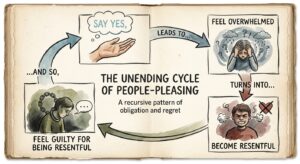
8. You Feel Like You Have to Be “The Easy One”
- You don’t want to be difficult.
- You don’t want to need too much.
- You don’t want to inconvenience anyone.
- You don’t want anyone to be upset with you.
Eventually, being easy for everyone else can become exhausting for you.
Understanding Your People-Pleasing Patterns
Recognizing that you may be a people-pleaser can bring a mix of relief, frustration, and even sadness. You may begin to see how often you’ve put your own needs aside to avoid conflict, gain approval, or make sure the people around you are okay. Most importantly, understanding these patterns isn’t about blaming yourself—it’s about becoming more aware of what you’ve learned and why it may no longer be serving you.
The good news? People-pleasing isn’t something you’re stuck with. Learning to recognize your patterns is the first step toward developing healthier boundaries, communicating your needs, and building relationships where you don’t feel responsible for everyone’s happiness.
Individual Therapy for People Pleasing in Concord, NC, Denver, NC, and Mooresville, NC
Ready to Take the Next Step?
In our next article, we’ll move from understanding people-pleasing to changing it. We’ll explore practical ways to break the cycle, learn to say no without overwhelming guilt, set healthier boundaries, and begin putting your own needs back into the picture.
Read next: Breaking the People-Pleasing Cycle: How to Set Boundaries Without the Guilt.
Related Posts

The obstacles to changing your life to know
Overcoming the Obstacles to Change We are excited to share this latest article...

When “I’m Fine” Is a Habit: How Emotional Suppression Impacts Mood Over Time
“I’m fine” is a phrase we all have used at least once or twice….maybe hundreds of...

What Makes Art Therapy Unique
What is Art Therapy Written by: Brandy Prabucki, LCMHC, ATR Art Therapy is...

Coping better with Pandemic Anxiety
In addition to an increase in the prevalence of depression, as discussed in our...